
What defines the North America raisins market?
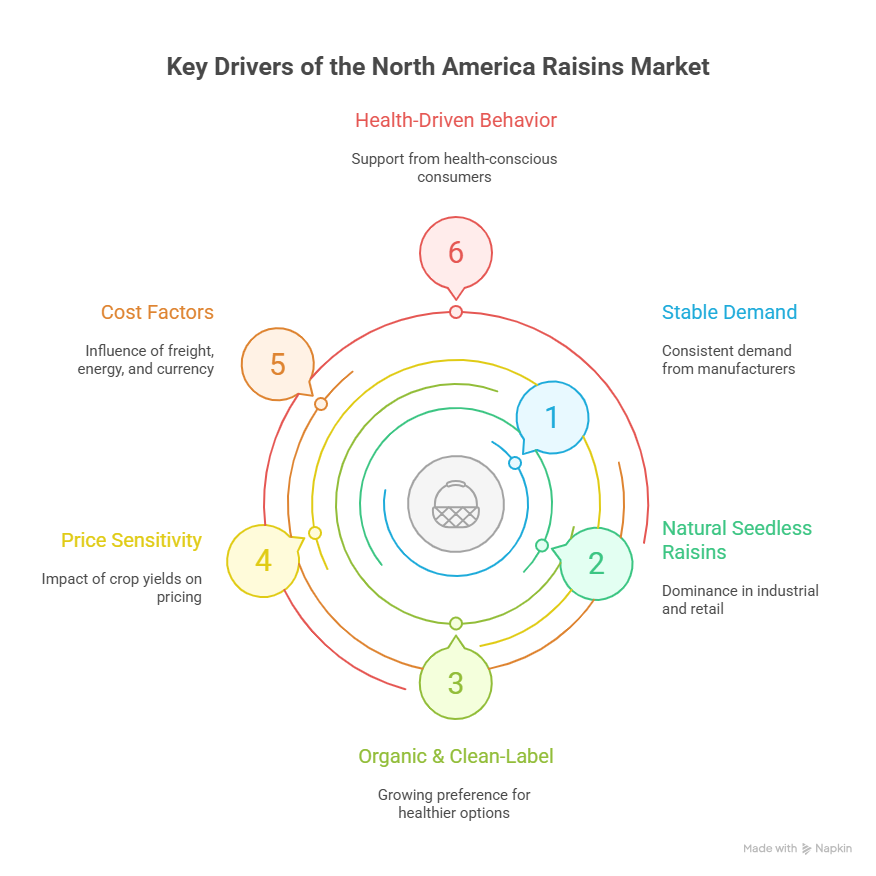
The North America raisins market is defined by the following key factors:
Stable year-round demand from bakery, cereal, and snack manufacturers
Dominance of natural seedless raisins in both industrial and retail applications
Growing preference for organic and clean-label products, especially in the US and Canada
Price sensitivity to crop yields in California and major global producing countries
Impact of freight, energy, and currency costs on import pricing
Health-driven consumer behavior, supporting demand in breakfast and on-the-go snacks
North America Raisins Market: Demand Trends, Pricing and Consumer Insights
What defines the North America raisins market today? Driven by steady industrial consumption, rising health awareness, and clean-label food innovations, the global raisins market is undergoing dynamic growth. North America represents approximately 19.5% of the global market share, serving as both a major production powerhouse (centered in California) and a massive consumer region for high-grade dried fruit.
Whether you are a bulk distributor, food manufacturer, or B2B importer, understanding regional shifts across the US raisins market, Canada, and global trading hubs like the Europe raisins market and Spain raisins market is essential for strategic sourcing and volume forecasting.
This article gives you a concise yet powerful overview of current demand patterns, price behaviour, and consumer preferences. Understanding how different varieties compete—such as the comparison between Golden Raisin vs. Sultana—helps buyers make better sourcing decisions and sharper forecasts.
Growing Demand Across Food Manufacturing and Retail
The North America raisins market maintains steady year-round demand driven by bakery, cereal, confectionery, and snack bar manufacturers. Processing quality, including controlled treatments like optimal sulfuring duration for golden raisins, plays a key role in meeting industrial specifications.
Food companies rely on raisins as a natural sweetening ingredient, while retailers continue offering them in numerous pack formats. For importers, knowing where to buy Iranian raisins with consistent quality is a practical concern rather than a marketing choice.
Cereal producers in the US dominate industrial use, while Canada shows strong performance in organic and clean-label categories. Meanwhile, demand for darker varieties such as Sultana Dark Raisin continues to grow in Mexico’s snack and value-retail segments.
Product Preferences Shaping Market Structure
North America shows clear interest in natural seedless raisins due to their versatility in both industrial and retail applications. Processing details—such as different oil coating methods in Sultana raisins—directly influence texture, shelf life, and buyer acceptance.
Golden seedless varieties are gaining traction as consumers seek products with appealing colour and consistent flavour. Premium formats like Golden Raisin & Long Golden Raisin are increasingly used in bakery toppings and specialty snack mixes.
Clean-label trends encourage the growth of unsulfured and organic options, especially in the US and Canada. As a result, exporters must carefully manage quality risks such as golden raisin defect types in export batches to meet stricter buyer standards.
Pricing Trends and the Factors Behind Them
Raisin prices in North America fluctuate with global crop conditions, freight costs, and currency movements. Compliance-related factors, including acceptable limits for residual sulfur dioxide in golden raisins, can also affect pricing and market access.
Freight and energy costs also affect CIF prices into Canada and Mexico. Traders monitor currency fluctuations because a stronger US dollar can increase the cost of imported raisins, shifting demand toward domestic supply when available.
Key Drivers of the North American Raisin Industry
Industrial Demand in Bakery & Cereal: Industrial buyers in the US and Canada utilize natural seedless and golden raisins as natural sweetening agents and functional ingredients.
Shift Toward Clean-Label & Organic: Increasing consumer preference for unsulfured, organic, and non-GMO dried fruits.
Packaging Versatility: Strong growth in single-serve, bulk industrial cartons, and resealable retail pouches.
Export & Import Fluctuations: Price dynamics linked to California crop yields, global freight costs, and import regulations regarding sulfur dioxide ($\text{SO}_2$) residues.
Practical Considerations for Buyers and Importers
Buyers navigate a market shaped by price volatility and shifting consumer preferences. To manage these challenges, importers often diversify supply sources and negotiate long-term contracts. They also pay close attention to grade specifications, moisture levels, colour uniformity, and packaging standards.
1. Determine exact usage requirements
Identify whether raisins are for bakery, cereals, retail packs, or mixed snacks to select the right grade and variety.
2. Time purchases around crop cycles
Monitor major producing regions to reduce exposure to price spikes caused by weather-related shortages.
3. Diversify supply origins
A balanced mix of domestic and international sources helps maintain stable pricing and consistent quality.
Market Segmentation & Regional Overview
To better understand market dynamics, here is how key geographic regions and product segments compare in the current global and regional market landscape:
| Region / Market Segment | Key Characteristics & Market Trends | Regional Focus / Growth Rate |
| US Raisins Market | Primary production center (California Natural Seedless); heavy industrial usage in cereals and bakery. | Dominates regional supply & brand development. |
| Canada Raisins Market | Highly import-dependent (~$68M+ annual import volume); strong focus on retail, private labels, and organic snacking. | High demand for premium packaging & clean label. |
| Europe Raisins Market | Strict food safety standards (MRLs, microbiological controls); valued at over $1.2B with steady annual growth. | Focus on organic, verified origin & compliance. |
| Spain Raisins Market | Strategic European hub; growing confectionery and bakery demand with market expansion toward $85M+. | Steady growth (~4.8% CAGR). |
Canada Raisins Market: Category & Packaging Breakdown
Canada represents one of the most structured markets for dried fruit imports in North America. Analyzing the Canada raisins market by category and Canada raisins market by packaging type offers crucial insights for exporters:
1. Canada Raisins Market by Category
Natural Seedless Raisins: Accounts for the largest volume share, heavily utilized by commercial bakeries and breakfast cereal producers.
Golden Seedless Raisins: Preferred in premium bakery applications, confectionery, and gourmet snack mixes due to bright visual appeal.
Organic & Unsulfured Raisins: Fastest-growing category in Canadian retail grocery channels, catering to health-conscious consumers.
Sultana & Specialty Varieties: Popular in ethnic food retail segments and specialized food processing.
2. Canada Raisins Market by Packaging Type
Bulk Industrial Cartons (10 kg / 12.5 kg): Standard for B2B food manufacturers, commercial bakeries, and repackers.
Resealable Stand-Up Pouches (Pouch Packaging): Popular in retail for maintaining freshness, moisture control, and shelf stability.
Single-Serve & Snack Packs: Driven by school lunchbox demand and on-the-go snacking trends.
Clamshells & Rigid Containers: Commonly used in club stores and bulk-retail formats.
Global Variety Comparison: Natural Seedless vs. Golden vs. Sultana
Understanding product specifications helps buyers make informed purchasing choices based on application, visual criteria, and regulatory limits:
   [ Raw Grapes ]
         │
         ├──► Sun-Dried (Natural Drying) ──► Natural Seedless Raisins (Dark, Sweet)
         │
         ├──► Dipped & Sun-Dried ─────────► Sultana Raisins (Light Brown, Juicy)
         │
         └──► SO2 Treated + Dehydrated ──► Golden Seedless Raisins (Bright Gold)
Natural Seedless: Sun-dried, naturally sweet, robust dark color. Ideal for industrial baking, granola, and everyday snacking.
Golden Raisins: Treated with sulfur dioxide ($\text{SO}_2$) and oven-dried to maintain color uniformity. High demand in specialty baking and confectionery.
Sultanas: Processed using oil-emulsion dips for fast drying; retains light amber tones and soft texture, popular across European and international markets.
Outlook for 2026 and Beyond
Market forecasts suggest steady growth supported by clean-label products, organic demand, and continuous innovation in snack and cereal categories. Opportunities exist for suppliers who provide high-quality raisins with strong traceability and reliable logistics.
FAQ
Which type of raisins is most popular in North America?
Natural seedless raisins dominate due to their versatility in industrial and retail applications.
Are raisin prices stable in North America?
Prices fluctuate with crop yields, freight costs, and currency movements, but long-term demand remains steady.
Is demand for organic raisins increasing?
Yes. Organic and unsulfured raisins show strong growth, especially in the United States and Canada.
📞 Contact Us & Bulk Sourcing Inquiries
For expert consultation, current price quotes, and placing bulk export orders for all varieties of raisins, please contact us via the options below:
📞 Phone: +989357818868
✉️ Email: info@raisiniran.com
💬 WhatsApp: Chat on WhatsApp